
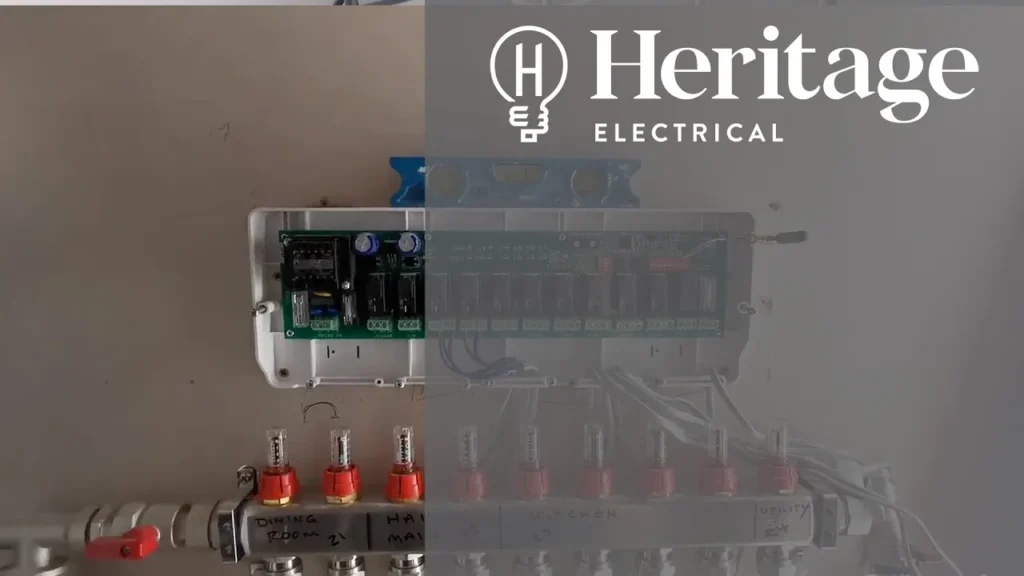
I get called out to broken Heatmiser underfloor heating systems more than any other job. And in the vast majority of cases, the problem isn’t the Heatmiser equipment. Heatmiser make excellent products. The UH8 wiring centre, the Neostat thermostats, the NeoAir wireless stats. These are well-engineered, solid bits of kit when they’re installed correctly.
The problem is almost always the installation.
Underfloor heating sits in an awkward gap between trades. The plumber commissions the wet side: the manifolds, the loops, the pipework. The electrician connects the controls. And somewhere between the two, nobody takes ownership of the full system. The controls get rushed, the wiring doesn’t get labelled, the thermostats get paired wrong, and the homeowner ends up with a system that either runs constantly or doesn’t run at all.
I’ve walked into heating cupboards that looked like someone had emptied a bag of cables into a box and shut the door. I’ve seen UH8 units completely destroyed because an engineer connected 230 volts to the wrong terminals. I’ve seen twelve heating loops with not a single one labelled, paired to two thermostats that were supposed to control all of them. These aren’t edge cases. This is the job, most of the time.
Here’s what I find, and what fixing it properly involves.
The four problems I find on almost every call-out
1. Unlabelled or incorrectly labelled heating loops
This sounds basic, but the consequences are significant. On a typical large property, there might be two manifolds controlling ten or twelve underfloor heating loops across the ground floor: kitchen, hallway, dining room, utility, bathrooms. If the loops aren’t labelled at the manifold, nobody knows which actuator controls which zone.
What usually happens is the plumber commissions the wet side and moves on without documenting which loop goes where. By the time I arrive, the homeowner has no idea either, and neither does anyone else. We have to trace each loop manually. Close each actuator in turn, feel which zone goes cold, and label from scratch.
It’s time-consuming, but it’s essential. Without accurate labelling, you can’t pair the thermostats correctly, and without correct pairing, the system will never behave predictably.
On one job I attended recently, we had a large ground floor with two UH8 hubs controlling multiple manifolds, and the original installer hadn’t labelled a single loop. The plumber’s notes were non-existent. Everything had to be mapped from the beginning before we could do anything else.
2. Incorrectly wired UH8 wiring centre
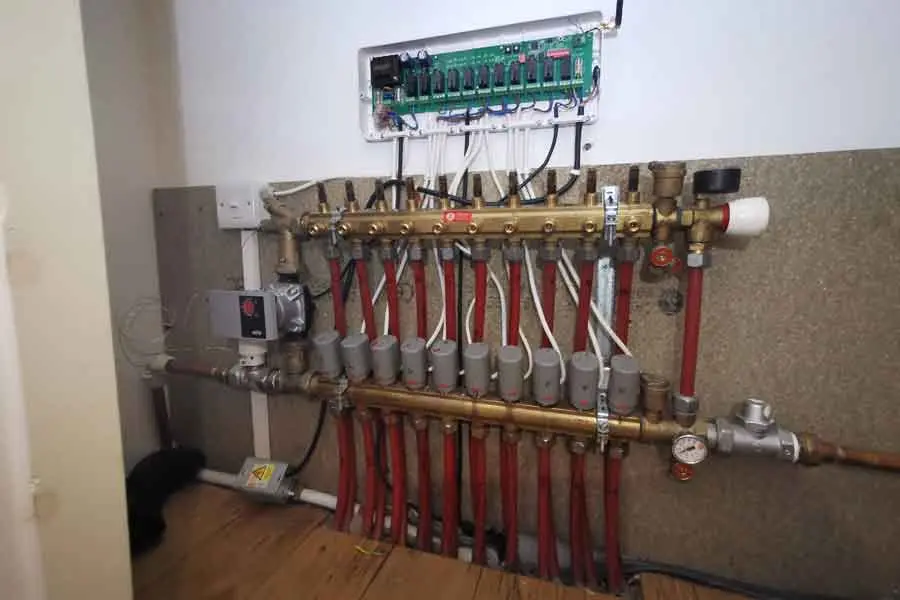
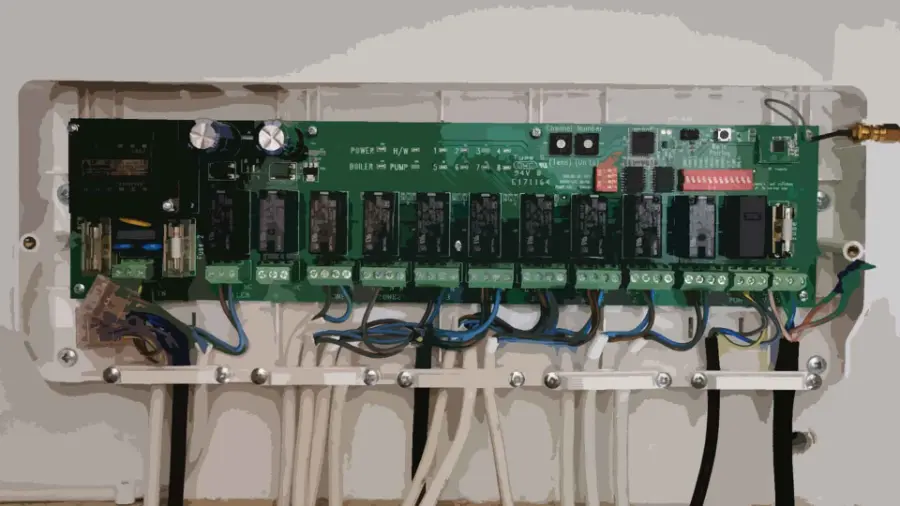
The UH8 is the brain of the system. It controls the actuators on the manifold, the boiler, the pump, the zone valves, and the hot water cylinder if there is one. It communicates with the Neostat thermostats (or the NeoAir wireless stats if you’re using the RF version) to fire the boiler as each zone calls for heat.
The wiring is not especially complicated if you understand the system. But if you don’t, it’s easy to get wrong in ways that range from annoying to catastrophic.
The most common benign errors are actuator wiring in the wrong order, or boiler demand wired incorrectly so the boiler doesn’t fire when zones call for heat. These are fixable. The system doesn’t work properly, but nothing is damaged.
The more serious errors involve the 230-volt outputs on the board. On one job, the previous installer had connected a 230-volt output from the UH8 to the boiler’s programmer control terminals, which are expecting a low-voltage signal, not mains voltage. It destroyed the UH8. It also destroyed one of the boilers. Both had to be replaced before we could even begin setting the system up correctly.
I’ve seen this more than once. The UH8 isn’t fragile, but it won’t survive mains voltage being fed into signal terminals. When I’m quoting for a remediation job, one of the first things I check is whether the UH8 is still functional, because if it isn’t, that changes the scope considerably.
3. Incorrectly paired thermostats
This is probably the most common fault I find, and it’s the one that produces the most baffling symptoms for homeowners. Rooms that won’t heat. Zones that seem to call for heat but nothing happens. Rooms that are always warm regardless of what the thermostat is set to.
The assumption that causes most of these problems is this: one thermostat can control multiple heating loops. It can’t, not in the way most people wire it.
Each Neostat or NeoAir thermostat needs to be paired to the specific zone or zones it controls on the UH8. If a thermostat is paired incorrectly, it may be calling for heat in a zone that isn’t physically connected to the rooms it’s measuring, or not calling for heat at all despite the temperature being set correctly.
On one job, the plumber had assumed a single thermostat could control two adjacent rooms that shared a loop. The rooms had different heat requirements, different usage patterns, and different temperatures as a result. Splitting them into separate zones with individual thermostats was straightforward once the loops were correctly labelled, but it required additional stats and a proper re-pairing of the whole system.
The other pairing issue I see regularly is with the wireless NeoAir stats. These communicate with the RF version of the UH8 hub via radio frequency. If the pairing isn’t done correctly, or if the stat is too far from the hub for reliable communication, the system drops out. The thermostat appears to be set correctly, the app shows the schedule running, but the zone isn’t responding because the hub isn’t receiving the signal.
4. Wireless stats out of range for app control
The NeoAir wireless thermostats are a good solution for retrofitting underfloor heating control without running cables through finished floors. But wireless range in older properties with stone walls, thick masonry, multiple floors, can be a genuine problem.
The symptom is intermittent. Sometimes the app works, sometimes it doesn’t. Sometimes a zone responds, sometimes it doesn’t. The homeowner assumes there’s a fault with the thermostat or the hub, when the actual problem is that the radio signal between the stat and the UH8 is unreliable.
There are a few ways to address this depending on the property. Sometimes it’s repositioning the hub. Sometimes it’s adding a repeater. Sometimes the right answer is to hard-wire the stats properly rather than relying on wireless, which is what I’d always prefer where it’s possible. Wireless is a practical solution for retrofit situations, but for a new installation or a full remediation, hard-wired stats are more reliable and easier to diagnose when something goes wrong.
What happens when none of this gets addressed
The system gets left in one of two states. Either someone has wired the boiler demand permanently on, which means the heating runs constantly regardless of thermostat settings, and the homeowner assumes the controls just don’t work and gives up. Or the boiler demand isn’t connected at all, and the system never fires, so the heating doesn’t work at all.
I’ve walked into both. On one job the homeowner had been living with their heating on permanently for two winters because the original installer told them it was a problem with the Heatmiser equipment. It wasn’t. The UH8 boiler demand connection had been wired incorrectly. The system wasn’t defective. It had never been set up properly.
This is worth being clear about: in the vast majority of cases where I’m called out to a Heatmiser underfloor heating system that isn’t working, the equipment is fine. The product isn’t the problem. Heatmiser build good kit. The problem is almost always installation: wrong connections, wrong pairing, wrong labelling, or nobody having taken the time to understand how the full system is supposed to work before starting.
What a proper remediation looks like
When I attend a job like this, the first thing I do is assess the full system before touching anything. That means checking the UH8 for damage, tracing and labelling all loops at the manifold, checking every wiring connection against the Heatmiser documentation, identifying which thermostats are paired to which zones and whether that pairing is correct, and checking the RF signal strength on any wireless stats.
Only once I know exactly what the system is supposed to do and what it’s currently doing does it make sense to start making changes. Rushing into rewiring before you understand the full picture is how you turn one problem into three.
The remediation on most jobs involves: relabelling loops, correcting actuator wiring, correcting boiler demand connections, re-pairing thermostats to the correct zones, testing each zone individually, and then testing the full system together.
On more complex jobs, where the UH8 has been damaged, or where there are additional faults with the wider electrical installation, the scope is larger. On one job I attended, beyond the underfloor heating system itself I found loose breakers on the three-phase board, isolators underrated for the boiler load, and cabling that didn’t meet manufacturer requirements. These aren’t heating problems, they’re electrical safety issues. But they tend to appear together because when one trade has cut corners, others usually have too.
If your Heatmiser underfloor heating isn't working
The first thing to establish is whether it’s ever worked. If it’s a new installation that’s never functioned properly, the problem is almost certainly installation: incorrect wiring, incorrect pairing, or the boiler demand not being set up correctly. If it’s a system that used to work and has stopped, the causes are different: a failed actuator, a stat that’s lost its pairing, a UH8 that’s been damaged.
Either way, a proper diagnosis takes time and needs someone who understands the full system: the wet side, the controls, the boiler interface, and the smart home integration if there is one. It’s not a job for someone who’s going to look at it for twenty minutes and guess.
I work nationally and I get called out to these jobs regularly, across Devon, Cornwall, Hampshire, Dorset, and further afield. If your underfloor heating system isn’t doing what it should, get in touch and we can talk through what’s likely going on. Often a short conversation is enough to establish whether it’s something straightforward or whether it needs a proper site visit.
Book a call with Paul or send a message on WhatsApp. Photos or short videos of the heating cupboard and the UH8 setup are genuinely useful and save time on a lot of jobs.
Paul Watson
a NICEIC approved contractor and specialist in Heatmiser installation, repair, and remediation. He has over 20 years' experience in electrical engineering and automation, and is regularly called in to resolve Heatmiser installations that other engineers have been unable to fix. View his Heatmiser work on YouTube.